

 Team Hashtag
NEP 2020 Preschool Curriculum Activities for Parents Explained Simply
NEP 2020 preschool curriculum activities for parents search query barely existed two years ago, and is now one of the fastest-growing education searches in India. The reason is simple: the National Education Policy 2020 fundamentally changed what preschool education is supposed to look like, and parents are scrambling to understand what this means for their children.
Here is the good news: NEP 2020 does not ask parents to become teachers. It asks parents to do what many already do instinctively: play with their children, talk to them, read to them, and let them explore. The policy validates these approaches as legitimate, essential education.
What NEP 2020 Actually Says About Preschool
The policy introduces a 5+3+3+4 school structure where the first stage, the Foundational Stage, covers ages 3 to 8. This is revolutionary because it officially integrates preschool into India’s formal education framework for the first time. Three core principles define the foundational stage. Learning should be play-based, activity-driven, and discovery-oriented. Assessment should be observation-based, not exam-based. Mother tongue or home language should be the primary medium of instruction in the early years.
What this means in practice: if your child’s preschool is giving written homework to a 3-year-old, conducting formal tests, or teaching exclusively in English while ignoring the home language, it is not aligned with NEP 2020.
7 NEP-Aligned Activities Parents Can Do at Home
Activity 1: Discovery Walks (Scientific Thinking)
NEP 2020 emphasises experiential learning through exploration. Take your child on a 15-minute walk and observe together. Count the birds. Name the colours of flowers. Feel different textures: smooth bark, rough stone, soft leaf. Ask why questions: why do you think birds sit on wires? Why are some leaves bigger than others? You are building scientific thinking through guided observation.
Activity 2: Storytelling in the Home Language (Language Development)
NEP 2020 strongly recommends mother tongue instruction in the early years. Tell stories in Hindi, Tamil, Bengali, Marathi, or whatever language your family speaks at home. Research consistently shows that children who develop strong language skills in their mother tongue transfer those skills more effectively to English later. You are not holding them back by speaking Hindi; you are building a stronger linguistic foundation.
Loved these ideas? Let’s bring them to life beyond the screen!
Discover Blueberry workbooks & box sets designed for joyful, hands-on learning.
🛒 Shop Now: https://hashtageducation.in/collections/box-set
Activity 3: Sorting and Classifying Household Objects (Mathematical Thinking)
NEP 2020 calls for activity-based numeracy development. Give your child a pile of mixed objects, such as spoons, buttons, clips, coins and ask them to sort by size, colour, or type. This is a classification of the mathematical skills that underpin everything from data analysis to algebra. No worksheets needed. Just a pile of household objects and a curious child.
Activity 4: Art Without Instructions (Creative Expression)
NEP 2020 values creativity as equal to literacy and numeracy. Give your child paper, crayons, and paint. Do not tell them what to draw. Do not show them a model to copy. Let them create freely. Ask them to tell you about their drawing. This open-ended creative expression builds imagination, self-confidence, and narrative skills. Guided art (copy this picture) builds motor skills. Free art builds creativity. Both matter, but NEP 2020 specifically highlights the importance of the latter.
Activity 5: Cooking Together (Life Skills and Numeracy)
NEP 2020 includes life skills as a formal part of the foundational curriculum. Let your child help in the kitchen, counting vegetables, pouring rice, mixing batter, and tearing lettuce. Cooking combines mathematics (counting, measuring), science (transformation, temperature), language (naming ingredients, following instructions), and motor skills (pouring, stirring, kneading) in a single meaningful activity.
Activity 6: Role Play and Pretend Play (Social-Emotional Development)
NEP 2020 gives equal weight to social-emotional development alongside academic skills. When your child pretends to be a doctor, teacher, shopkeeper, or parent, they are practising empathy, communication, problem-solving, and self-regulation. Set up simple role-play scenarios with household props. A chair becomes a doctor’s office. Cushions become a restaurant. Stuffed animals become students. This is not wasted time; it is NEP-aligned foundational education.
Activity 7: Building and Construction (Spatial and Logical Thinking)
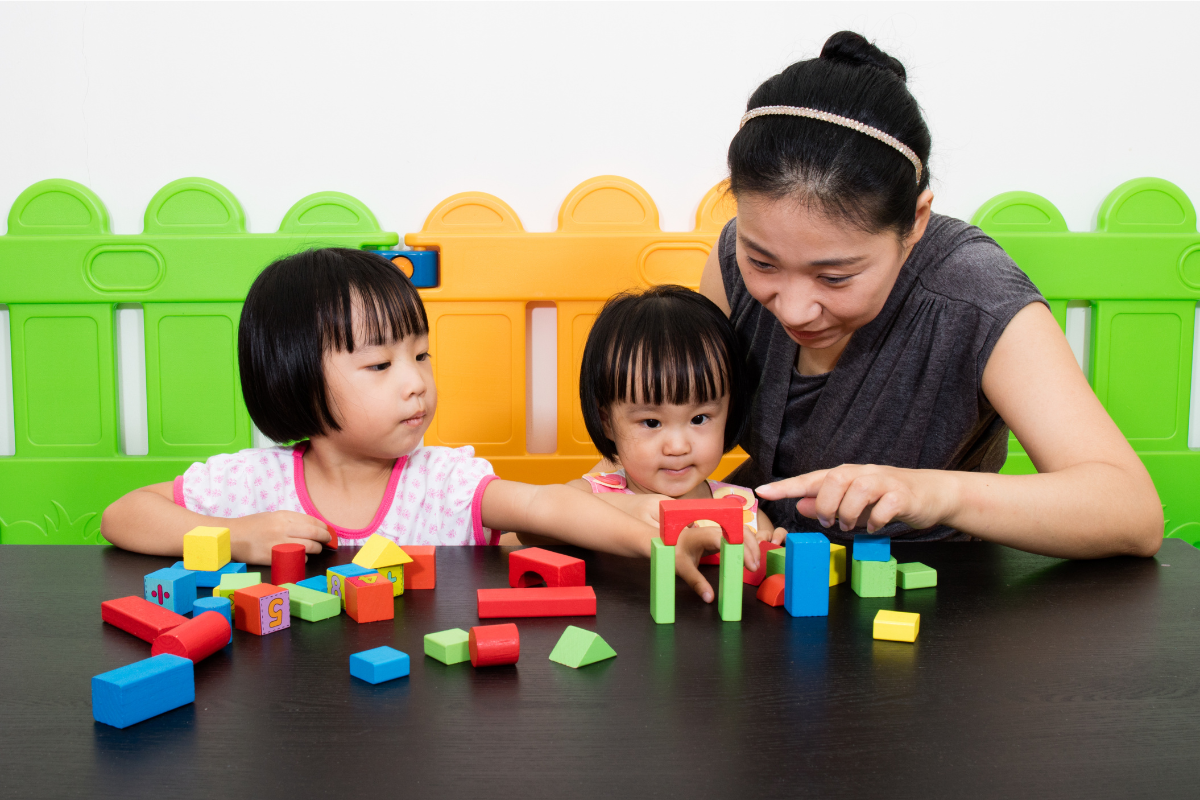
NEP 2020 promotes hands-on, manipulative-based learning. Blocks, Lego, boxes, cushions, anything your child can stack, arrange, balance, and build develops spatial reasoning, engineering thinking, and problem-solving. Ask questions during building: what happens if you put a big block on top of a small one? How can you make it taller without it falling? Why did it fall? These questions build the scientific reasoning process that NEP 2020 values over rote answers.
How Our Platform Aligns With NEP 2020
Our courses are designed to align with NEP 2020 foundational stage guidelines. Activities are play-based and interactive, ensuring children learn through exploration rather than memorisation. The curriculum progresses through developmental milestones instead of arbitrary academic benchmarks.
Read Also: Indoor play ideas to stimulate young children at home
Content is available in both English and Hindi, supporting the bilingual approach recommended by NEP 2020. Assessment is observation and milestone-based, never exam-based. The Treasure Chest resources also include hands-on, discovery-oriented activities that reflect the core principles of the policy.
The Bigger Picture
NEP 2020 is not just a policy document. It is a philosophical shift in how India thinks about early childhood education. It moves the conversation from ” What does my child know? How does my child think, feel, create, and explore? Parents who understand this shift and act on it at home give their children an advantage that lasts far beyond preschool.