
6 future-ready skills for children Needs Today
Good grades alone won't prepare children for tomorrow's world. Discover 6 future-ready skills for children — from critical thinking and creativity to empathy and digital literacy — and how parents and teachers can nurture them together.
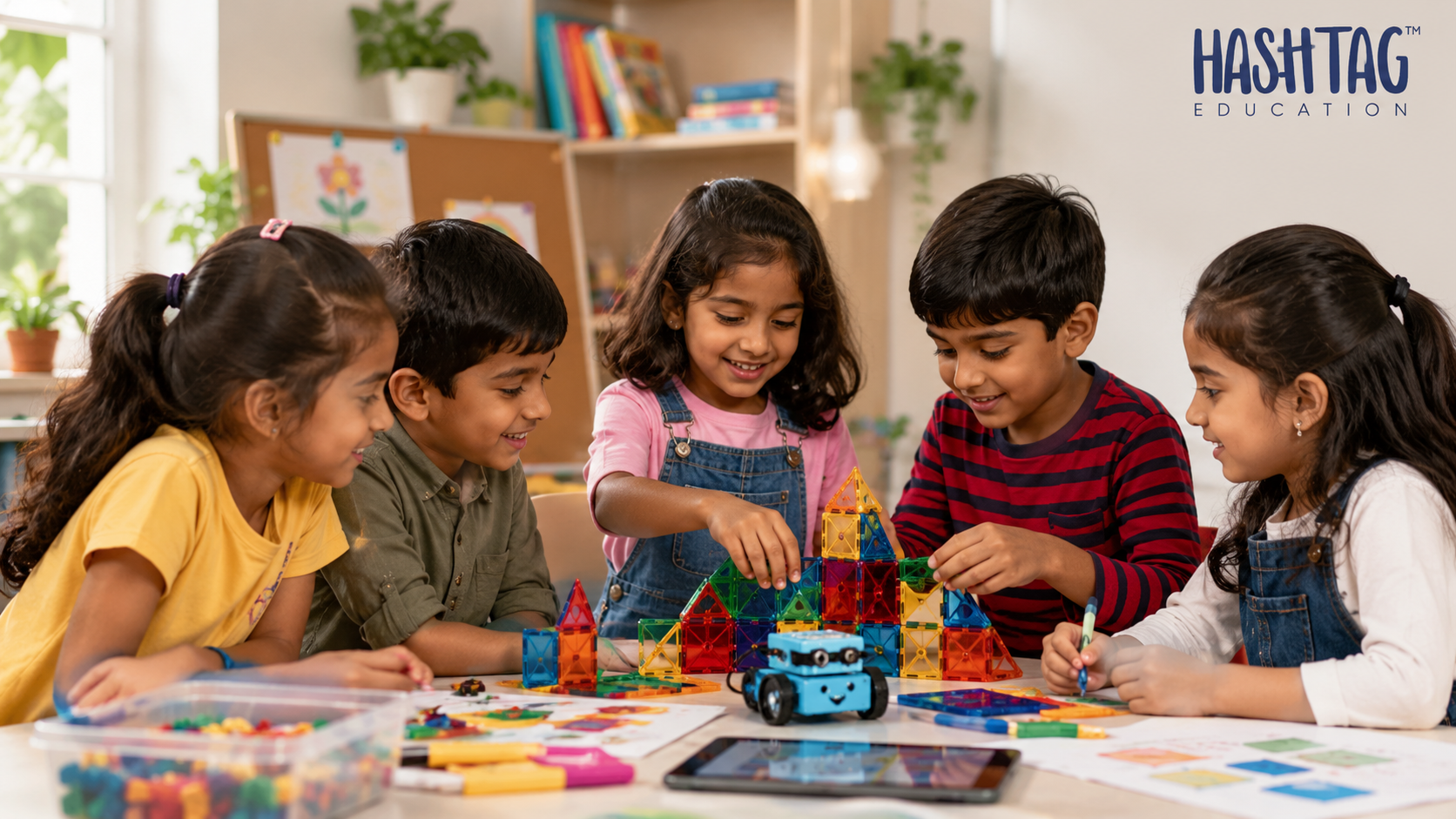
Future-ready skills for children matter more than ever. In today's fast-changing world, good grades alone no longer guarantee success. Academics give a vital foundation, but children need much more to truly thrive. To raise confident, capable, and compassionate adults, we must nurture abilities that reach far beyond the classroom.
This is what it means to raise future-oriented children: those who have the imagination, adaptability, resilience, and mindset required to face life’s obstacles head-on.
Why Academics Alone Aren't Enough
Traditional education focuses on facts, calculations, and tests. However, the world children are growing up in today requires more than memorisation. They have to have the capacity for critical thought, problem-solving, open conversation, and lifelong learning.
The goal of 21st-century skills is to prepare kids for life in general, not simply for school. It’s about giving learners the abilities they need to ask, create, cooperate, & adapt skills that will be useful regardless of how the world changes.
6 Essential Future-Ready Skills for Children
Let’s examine six crucial life skills that every youngster should acquire in order to prepare for the future. Every day, both at home and at school, as well as via significant real-world experiences, each may be fostered.
1. Problem-Solving and Critical Thinking
The skill of critical thinking involves posing queries, investigating many viewpoints, and coming up with original answers. Children who solve problems are better able to remain composed, self-assured, and inquisitive when faced with obstacles.
How to cultivate it:
Instead of offering just answers, encourage them to question “Why?” and “How”. Give examples of real-world difficulties (such as organising a birthday or a trip).
Allow them to make little choices, even if they result in errors.
Together, consider the lessons they took away from each encounter.
Play puzzle or logic games to hone your reasoning abilities.
Children learn from such events that there are several solutions to every issue and that having a unique perspective is an asset.
Looking for a fun spelling activity?
This game helps kids practise words, letters, and vocabulary through hands-on play.
👉 Shop now: https://amzn.to/4wPF9mu
2. Innovation & Creativity
Creativity is the one ability that robots cannot replace in a world when automation and technology rule the day. It gives kids the opportunity to dream, create, and innovate skills that are crucial for future leaders, scientists, artists, and business owners.
How to cultivate it:
Promote free-form pursuits like construction, storytelling, and sketching. Allow them to experiment without worrying about being “wrong.”
Combine topics, such as math and music or science and art.
Appreciate their inquiry as well as the outcome.
Give them time to play freely and let their imaginations run wild.
Children learn to see the world not just as it is but as it could be when creativity is fostered.
Read Also: Summer Holiday Activities for Kids: Fun Ideas That Beat the Boredom
3. Cooperation & Communication
In today’s interconnected world, the capacity to communicate ideas clearly as well as to listen and collaborate effectively with others is essential. While collaboration fosters respect and teamwork, communication increases self-assurance.
How to cultivate it:
Encourage youngsters to share their feelings and ideas.
During family discussions, engage in active listening. Include them in easy group activities, such as organising a game or dinner.
Allow them to participate in events in both leadership and assisting roles.
Prioritise empathy and teamwork above rivalry.
Children learn the value of empathy and connection when they are able to work together and interact honestly.
4. Media and Digital Literacy
These days, technology is a part of every child’s world. Teaching them digital literacy enables them to use it responsibly, not only for content consumption but also for safe creation, exploration, and learning.
How to cultivate it:
Teach children internet etiquette and appropriate screen usage.
Encourage children to think critically about what they read or see online.
Motivate them to produce digital works of art, tales, and movies. Talk about compassion, empathy, and privacy in online environments.
Make use of educational applications that encourage creativity and curiosity.
Instead of protecting kids from technology, the objective is to enable them to utilise it sensibly and responsibly.
5. Self-Control, Flexibility, and Initiative
Adaptability, the capacity to maintain composure and concentration in the face of change will be necessary in the future. Lifelong independence is developed by teaching kids how to control their emotions, take initiative, and maintain organisation.
How to cultivate it:
Assign kids simple yet significant tasks.
Encourage them to follow routines and make their own time plans.
Discuss emotions and set an example of constructive coping mechanisms.
Use setbacks to build resilience. Ask them: 'What did you learn from this?
Youngsters who are adept at controlling themselves develop into adults who take responsibility for their goals rather than waiting for guidance.
6. Empathy & Global Awareness
Children need to learn to think globally, act empathetically, and value diversity in an interconnected world. While global awareness enables individuals to perceive their role in the wider globe, empathy enables them to comprehend the viewpoints of others.
How to cultivate it:
Explore music, stories, and books from different cultures..
Discuss equity, empathy, and respect for everyone.
Engage kids in eco-friendly or communal projects.
Honour international festivals and customs.
Set an example of empathy in your day-to-day encounters.
Children naturally develop into more sympathetic, responsible global citizens when compassion and awareness grow together.
How Teachers and Parents Can Work Together to Nurture Powerful Skills for the Future
1. Change your perspective from “grades” to “growth.”
Give credit for effort, interest, and advancement rather than merely flawless outcomes. This fosters a passion of learning and intrinsic motivation.
2. Make Learning Out of Everyday Life.
Everyday activities, such as cooking, gardening, shopping, and travelling, are effective methods to teach responsibility, teamwork, numeracy, and creativity.
3. Promote learning through projects.
Allow kids to plan their own projects, whether they are building, writing, researching, or creating. Several 21st-century abilities are combined in these events.
4. Allow for errors.
Failure is a necessary component of success, not its antithesis. Allow them to attempt new things, make mistakes, and try again without worrying about being judged.
5. Set a good example.
Youngsters mimic what they observe. Children instinctively imitate the curiosity, flexibility, and generosity of adults.
Using 21st-Century Skills in the Classroom
Academics and practical skills are combined in a true 21st-century education. A future-ready mentality is built on the “4Cs”: Critical Thinking, Creativity, Dialogue, and Collaboration. The image is complete when digital literacy, flexibility, and empathy are included. Children become wiser and smarter when households and schools collaborate to foster these traits, preparing them for a future in which learning, unlearning, and relearning will be ongoing.
Concluding Remarks
Our children will inherit a world that is both unexpected and full with opportunities. We must foster brains that are capable of critical thought, rapid adaptation, and compassion if we want them to flourish. We create future-ready children by fostering curiosity, creativity, self-assurance, and compassion. These children are not only excellent scholars but also intelligent, capable, and compassionate people who are prepared to take the lead in the world. Let’s prepare our kids for life as well as tests.
Share your feedback
Tell us what you think about this post or the website. Approved messages may appear on the Hashtag Club page.