

 Team Hashtag
Brain Building Puzzles for Preschoolers
Puzzles for preschoolers stand out as one of the most potent yet overlooked resources for developing young children’s minds. If there were only one activity that could nurture the cognitive development of a child, puzzle games would surely top the list. It is an enjoyable blend of fun and learning, which allows for skill-building through play.
The act of picking up a puzzle piece marks the beginning of thought processes, experimentation, and discovery. The most distinctive feature of this toy is that it provides instant feedback to children. A puzzle piece fit correctly provides a sense of accomplishment, while the opposite results in a do-over situation.
Neuroscience Puzzles For Preschoolers
In the process of solving puzzles for preschoolers, the child’s brain of the child works simultaneously in several regions. The visual system perceives forms, colors, and patterns. The cognitive functions of the brain predict how the element will fit into its rightful place. The memory stores the patterns that the child remembers, and the motor skills direct the movement of the hand to fit the puzzle piece accurately.
This process occurs rapidly and repeats itself several times within one session. With each completed step, dopamine is released, motivating the child to perform further actions. Thus, the repetitive cycle stimulates the formation of neurons and improves cognitive and educational functions.
Scientific studies show that frequent activities with puzzles for preschoolers positively impact the development of spatial awareness. Spatial awareness is highly correlated with academic achievements in such disciplines as mathematics, science, and other analytical activities.
Selection Of Appropriate Puzzles For Preschoolers As Per The Age Group
It is essential to choose appropriate puzzles for preschoolers so that children are entertained but not bored with too much difficulty.
Age Group 1-2 Years (Pre-Nursery):
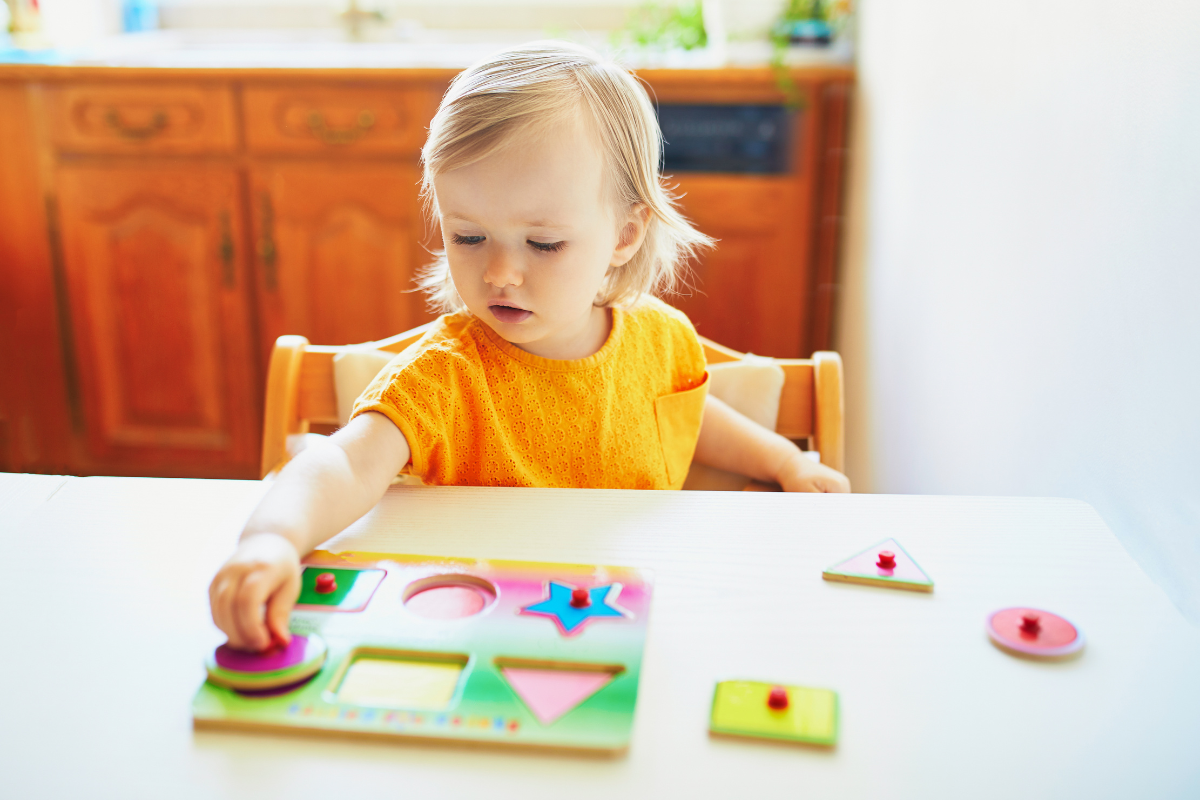
Puzzles made up of knobs with 3-5 pieces would be appropriate. Such types of puzzles will help in understanding shapes and building grip strength.
Age Group 2-3 Years (Nursery):
Puzzles made of chunky pieces with 6-12 pieces and easy-to-understand images will suit the age group. These puzzles develop spatial and matching skills.
👉 If you found this helpful, explore our Blueberry workbooks & box sets designed for joyful, hands-on learning.
🛒 Shop Now: https://hashtageducation.in/collections
Age Group 3-4 Years (Lower Kindergarten):
Use puzzles having 12-24 pieces, which are jigsaws. Such puzzles help children recognize patterns and think of their next move.
Age Group 4-5 Years (Upper Kindergarten):
Use puzzles with images that are complex, with 24-48 pieces.
How To Support Without Overruling
There are many things parents can get wrong when helping their preschool children solve puzzles. Although it’s natural to want to assist in the process, answering deprives the little one of an invaluable lesson.
Guide your kid in terms of how to approach this activity:
Point out what you notice in the puzzle (“Look! This is some part of the sky!”)
Ask open-ended questions about the solution (“What do you think goes here?”)
Stimulate the learning process rather than forcing it
Remember that speed isn’t the essence of puzzle-solving in preschoolers; it is the development of problem-solving abilities that should be emphasized in the process.
Digital And Physical Puzzles For Preschoolers
Currently, there are two types of puzzles that can be used by preschoolers: digital puzzles and physical puzzles, with each puzzle having its strengths.
The benefits of physical puzzles include:
Development of fine motor skills
Development of hand-eye coordination
Hands-on learning experience
The benefits of digital puzzles include:
Immediate feedback on performance
Automatic adjustment of the level of difficulty
Variety and increased engagement
Thus, the usage of both digital and physical puzzles in pre-schooling has the potential to be very beneficial.
Forming A Pattern Of Daily Puzzle Play
Puzzles should be consistent and predictable when introducing them to preschoolers. It can be tremendously helpful to integrate puzzles into your child’s daily life.
It’s important to have puzzles readily available at all times for your child to grab whenever they want. Present new puzzles to your child in small doses to keep them engaged.
Short, frequent puzzle play is far better for your preschooler than sporadic, long periods of time spent on puzzles.
Why Puzzles For Preschoolers Are So Effective
The explanation for why puzzles for preschoolers are so effective is that they incorporate different ways of learning all at once. Not only are the children entertaining themselves, but they are using their minds in other ways, too.
Puzzles help children:
Develop logical thinking
Improve concentration and focus
Build patience and persistence
Strengthen memory
Learn through trial and error
Because of these different skills combined in a single puzzle, puzzles are some of the most well-rounded learning tools for preschoolers.
Read Also: Playful Learning at Home
Practical Skills That Can Be Developed From Puzzles
Apart from the intellectual skills that puzzles develop, they also teach practical skills in preschool children. They are taught how to tackle problems, be patient, and continue with their work despite some failure along the way.
This experience gives them self-confidence and self-reliance. Over time, they will start viewing problems as things that need to be tackled and solved rather than avoided. This kind of attitude will serve them well both in education and later in life.
From this essay, it can be clearly seen that puzzles play a very important role in the intellectual development of preschool children. If exposed to this kind of game regularly, children will not only develop problem-solving skills but also confidence and self-reliance.
And most importantly, they will have fun doing it. Children get so involved in the activity that they will not find it boring at all.