
Interactive Learning Games India: 10 That Actually Teach
Not all "educational" apps actually teach. Discover 10 interactive learning games India that build real skills — what each one teaches your child, and how to spot the time-wasters.
Interactive Learning Games India: 10 That Actually Teach
Interactive learning games India are everywhere. App stores overflow with thousands of options, and every preschool platform claims to be educational. But parents who download randomly soon find the truth: most of these games are disguised ads, dopamine traps with no real learning, or confusing activities that teach nothing.
So what separates a genuinely educational game from a time-waster? Three things: intentional design (each game targets a real skill), the right difficulty (matched to your child's stage), and meaningful feedback (the child learns from mistakes, not just a buzzer).
What Makes a Game Truly Educational
A good learning game should target a specific skill, get harder as your child improves, give helpful feedback, have a clear start and end, and avoid ads, in-app purchases, and auto-play. Our Treasure Chest games are built against all five of these standards.
10 Game Types That Build Real Skills
1. Sorting Games — Drag objects into matching groups. Builds categorical thinking — the base of early maths.
2. Pattern Games — Complete a sequence of shapes or colours. Builds prediction and logical reasoning, the basis of maths and music.
3. Phonics Matching — Match a picture to its starting sound. Builds phonemic awareness — the strongest predictor of reading success. See our phonics guide for more.
4. Counting Games — Count objects and tap the right number. Builds number sense by linking the symbol "5" to five real things.
5. Memory Games — Flip cards to find pairs. Builds working memory — the mental space all learning depends on.
6. Sequencing Games — Arrange pictures to tell a story. Builds the order-thinking behind reading and word problems.
7. Shape and Spatial Games — Fit and rotate shapes. Builds spatial skills, a strong predictor of later STEM success.
8. Vocabulary Games — Tap the right picture when you hear a word. Builds vocabulary, a top predictor of school success.
9. Creative Games — Digital drawing, colouring, or music. Builds creative thinking and flexible problem-solving.
10. Comparison Games — Which is bigger, taller, or heavier? Builds the comparing skills behind real maths.
How to Use These Games Well
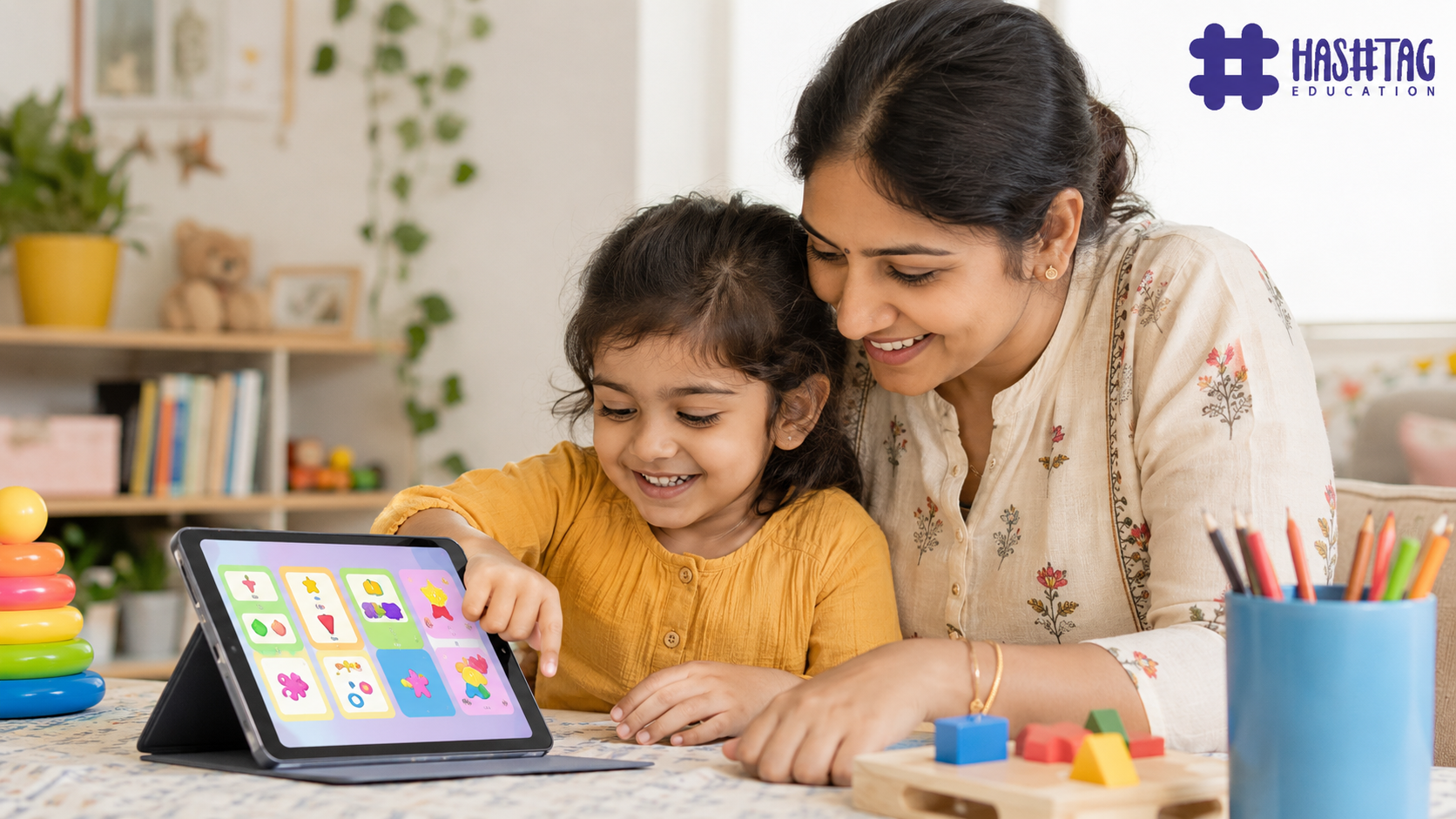
Interactive Learning Games India, Screen games help only when used the right way. Keep sessions to 10–15 minutes for ages 3 to 5. Sit with your child and talk while they play — ask "Why did you choose that one?" or "What happens next?" Rotate between game types instead of repeating one. And always follow screen time with a hands-on, physical activity. For ideas, try our play-based learning activities.
The screen should never replace real play. It should add a focused, skill-building 10 minutes to a day that's otherwise full of movement, talk, and hands-on exploration.
Our Approach to Learning Games
The games in our Treasure Chest section cover all 10 types above. Each one is mapped to a clear learning goal in our curriculum, designed for short 10-minute sessions, and linked to our Go Learn courses so children can reinforce concepts through play.
Most importantly, our games have no ads, no in-app purchases, and no auto-play. There's nothing designed to trap your child into passive scrolling. The focus stays on active, meaningful learning that keeps children engaged while building real skills — exactly what a learning game should do.
The Bottom Line
Not every "educational" app teaches. The good ones share clear signs: a real skill behind each game, helpful feedback, and no manipulative design. When you choose games this way — and play alongside your child — screen time becomes a genuine learning tool, not a babysitter. That's the difference between a child who's merely busy and one who's actually growing.
Share your feedback
Tell us what you think about this post or the website. Approved messages may appear on the Hashtag Club page.