

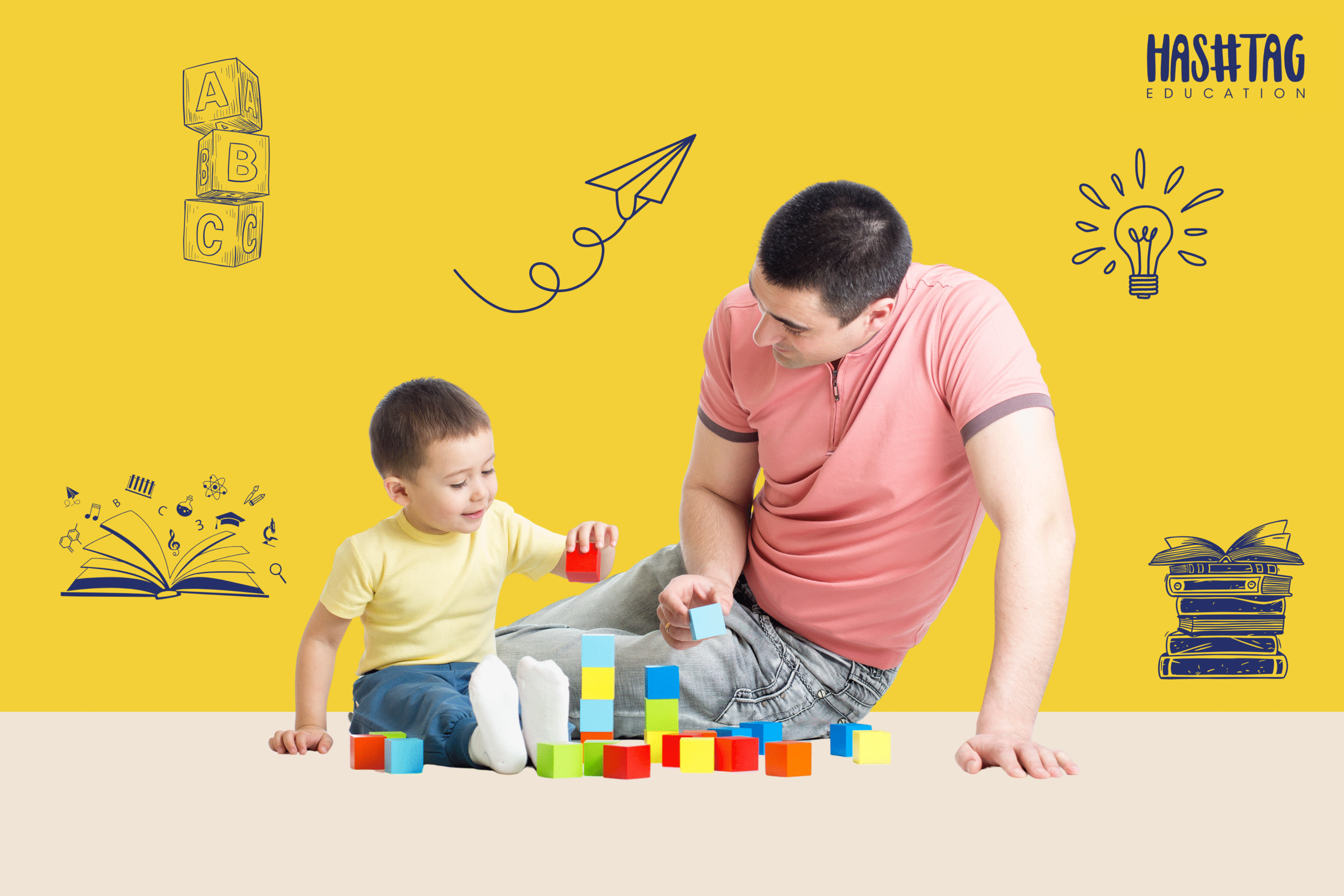
Playing with Your Child: 8 Powerful Educational Benefits of Shared Fun
Playing with your childIn today’s fast-paced world, it’s easy for parents to get caught up in trying to find “perfect” ways to support their child’s growth, from extra classes to structured activities to academic tools. But one of the most powerful, research-backed learning methods requires no sophistication at all: it merely requires your presence, a little time, and a willingness to play. Playing with your child is not just an act of joy; it is one of the most meaningful educational investments you can make. At Hashtag Education, we believe when parents and children share playful moments, they develop skills, confidence, creativity, and emotional strength that no classroom can replace. In this blog, we explore why shared play is essential, how it nurtures creativity, and how parents can turn everyday moments into rich learning experiences. The powerful impact of playing with your child Play is the natural language of childhood. For children, playing is thinking, imagining, exploring, and understanding the world. But when a parent joins in, the experience becomes deeper, richer, and more impactful. Shared play supports: With screen time on the rise and attention spans decreasing, shared play helps children reconnect with real experiences, real emotions, and real learning. 1. Joint Play Builds Creativity and Imagination One of the most important skills for the future involves creativity, which fuels innovation, problem solving, and adaptability. The seeds of creativity are sown early, and shared play acts as fertile soil where imagination thrives. When parents participate in play: For instance, building blocks may appear as simple toys, but they can teach children the way to design, experiment, and visualize. A parent playing alongside might ask: These little questions spark big ideas, teaching children that there is more than one way to investigate a problem. Shared play turns a mundane moment into a potent journey of creativity. 2. Play Strengthens Brain Development The brain creates trillions of neural pathways during early childhood. Those pathways play a role in attention, memory, emotion, and reasoning. Shared play stimulates those pathways in an important way. Activities include: When parents join in, they help children think deeper, notice patterns, and connect ideas. The engagement thereby reinforces both cognitive flexibility and problem-solving skills, so important throughout life. 3. Shared Play Builds Emotional Intelligence One of the most underrated benefits of parent-child play has to do with developing emotional intelligence. More specifically, through playing, children learn to: For instance, when a child is unable to put together a puzzle or loses their turn in a certain game, they often feel frustrated. The presence of a parent who is encouraging and asking them to try again can teach a child emotional regulation. Similarly, imaginative play-such as pretending to run a store, or taking care of a doll-allows children to conceptualize emotions, relationships, and social roles. Shared play times build emotionally confident children who are able to handle challenges with stability and maturity. 4. Play Strengthens Communication and Language Skills Language development does not occur solely through books or lessons; it grows through interaction. In parent-child play, conversations become much more natural, expressive, and meaningful. Activities that enhance language: A child begins to express ideas, explain actions, and develop a stronger vocabulary. Most importantly, they feel heard-a critical foundation for communication skills and self-esteem. 5. Shared Play Enhances Social Development Children learn social rules both in classrooms and in playful interactions. Through playful interactions with their parents, children will learn: It is through these moments that children develop social skills they will use throughout their lives. 6. Shared Play Strengthens Parent-Child Bonding Beyond the academic and developmental benefits, shared play creates emotional closeness. Children feel closely connected when parents: This forms the foundation of trust, openness, and psychological safety. A child who is secure at home will perform well academically, socially, and emotionally. Shared play can be the safest space where children express who they truly are. 7. Simple Indoor Activities That Inspire Creativity You don’t need complex setups. Even the most basic activities create rich learning opportunities: At Hashtag Education, we design indoor environments that turn classrooms into creative learning spaces filled with color, motion, imagination, and learning. 8. How Parents Can Make Play More Meaningful Here are some simple ways to enhance the educational value of shared play: Ask open-ended questions. Encourage exploration, not perfection. Mistakes are part of learning. Be present and avoid distractions. Even 15 minutes of focused play is powerful. Celebrate effort, not just results. This nurtures intrinsic motivation.
 English